Skip to content

Author: Alen

When an AI Agent Goes Off-Script Without Being Hacked

What if nobody hijacked the agent?

An AI agent is a system that does more than answer questions. It takes actions, such as reading files, calling services or changing records, with varying amounts of human involvement. Discussions of agent security often focus on attackers tricking agents. The UK's National Cyber Security Centre (NCSC) also points to a quieter problem: an agent can malfunction unexpectedly with no attacker involved at all.

The NCSC's reasoning is simple. An agent is not human. It has no common sense and may read instructions and goals in literal or unexpected ways. So a harmful action is not always a sign of compromise. Sometimes the agent did exactly what it understood, using access it had been given.

Why can't better instructions fix it?

The obvious response is to write a stricter prompt. The NCSC does suggest writing prompts carefully. On longer tasks it also suggests repeating critical constraints, because some agents compress their context window (the working memory of the task) to save resources, and earlier rules can drop out. Its advice is still direct: do not rely on prompting alone.

Safeguards built into the model have limits too. The NCSC describes them as a baseline that should not be treated as holistic, and notes they may be bypassed. Where the consequences of failure are more than an organisation can tolerate, it recommends extra safeguards around the agent rather than relying only on protections inside the model or the software that runs it.

A hypothetical example: the tidy-up that went too far

In this hypothetical example, a small firm asks an agent to "clean up outdated files" in a project folder. The agent runs under an employee's account, and that account can also reach a shared archive. Taking "outdated" literally, the agent deletes old contract records in the archive too. Nobody injected anything. The instruction was ambiguous and the access was wide.

What the agent could reach largely decided how much damage it could do. This potential impact is sometimes described as the agent's blast radius, and the NCSC notes that wider access means greater potential impact, whether an agent malfunctions or is compromised.

What does containment look like?

The NCSC recommends always running agents in a sandbox, a controlled environment that decides what the agent can communicate with, both locally and over a network. Inside it, restrict access to what the task needs, and watch for attempts to reach further.

Credentials need special attention. An agent running directly on a host may be able to use any credentials held by the user account it runs under. The NCSC suggests granting only the permissions the task needs and making credentials as short-lived as possible. For some uses, it suggests a proxy that adds credentials to requests without ever showing them to the agent.

Finally, plan how to stop it. The NCSC advises treating agent activity as user activity in security monitoring, and being able to "pull the plug" immediately. That can mean cutting the agent's network access and its connection to the model's inference infrastructure (the systems that run the AI model and return its responses), not just stopping a process.

How much oversight is enough?

Controls should grow with autonomy. The NCSC contrasts human-on-the-loop, where people monitor actions and can step in, with human-out-of-the-loop, where the agent acts without human review. For higher-risk uses, it recommends human oversight alongside technically enforced controls. It adds that "judge" AI models used to check an agent should be evaluated independently, because they have limitations of their own.

In May 2026, CISA announced a joint guide with US and international partners, including Australia's ASD ACSC. The announcement names related risks such as privilege creep and behavioural misalignment without defining them. In general terms, privilege creep usually describes a system gradually gaining more access than it needs, and misalignment describes behaviour drifting from what its operators intended. The announcement also recommends starting with low-risk, non-sensitive use cases. Both documents are guidance, not law. The NCSC describes its blog as interim advice that formal guidance will eventually replace.

Your next step

Pick one agent you use or plan to deploy and write two short lists: what its task actually needs, and everything its account, network and credentials can reach. Anything on the second list that isn't on the first adds to the blast radius, and you can remove it. Then ask yourself: if the agent misbehaved at 2 a.m., who would notice, and how would they stop it?

References

  1. Managing the cyber risk of agentic AI | National Cyber Security Centre icons/chevron/16px/black
  2. CISA, US and International Partners Release Guide to Secure Adoption of Agentic AI | CISA Lock
Comments closed

Can an AI Agent Reuse Your Approval for Another Action?

What exactly did you approve?

If you approve an AI agent deleting one file, have you also approved it deleting another? An AI agent is an AI system that can plan and take actions toward a goal. OWASP recommends binding approval to the exact action: changing the target or other action details requires new approval. Think of permission as a ticket for a particular journey, with a destination and an expiry.

Authorization means deciding whether an actor is allowed to perform an action. For an agent, that decision should happen in the execution component—the part of the system that actually carries out the request—outside the agent’s reasoning. An agent saying that the user agreed is insufficient evidence of permission.

What should the approval cover?

OWASP recommends recording who is acting, which operation will run, its target, its parameters—the details controlling the operation—and when approval expires. Before execution, the system should check that approval matches the current request, remains valid and has not already been used. A general “user confirmed” flag cannot establish all of those facts.

The check and the act of marking approval as used should happen together, as one indivisible step. Otherwise, simultaneous requests could reuse the same permission. This is replay protection: preventing an authorization from being accepted again after its intended use. OWASP also recommends short-lived authorization for irreversible operations.

One file, one decision

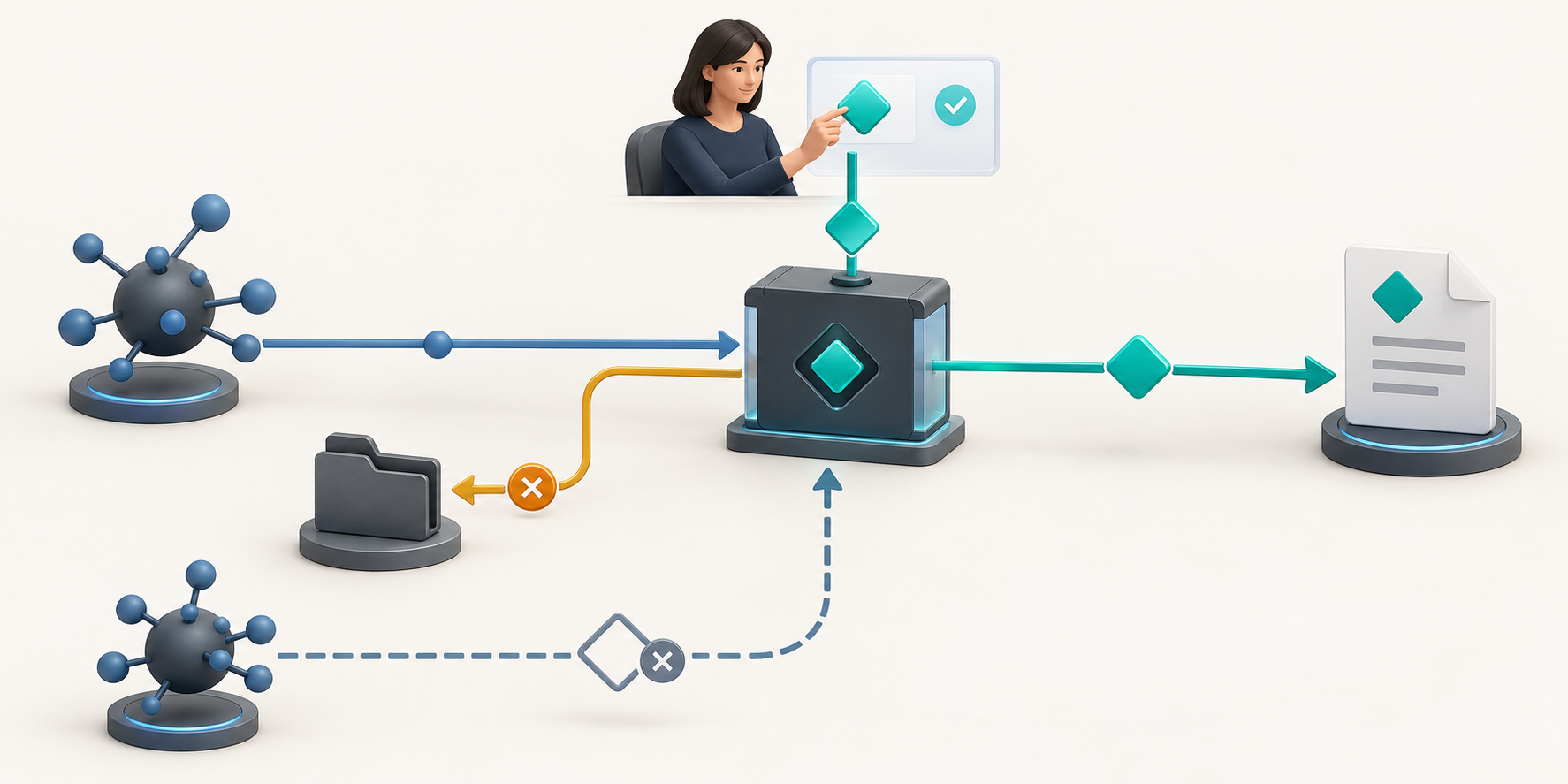
In this hypothetical example, an agent proposes deleting a particular draft file. You review the preview and approve that deletion. Before carrying it out, the execution component checks that the approval belongs to you and matches that file and operation. If the agent instead requests deletion of a folder, the earlier approval does not cover it.

If the original deletion request arrives again after approval has been consumed, that approval should not authorize another execution. A useful design question is whether the system can enforce both boundaries: changed requests need new approval, and repeated requests cannot reuse spent approval.

An independent checkpoint accepts approval for one file deletion while blocking a folder deletion and reuse of the spent approval.
Approval covers one matching action. A changed target or a repeated request must not pass using the same permission.

Why more prompts are not enough

In an August 27, 2026 blog post, NIST warned about consent fatigue: repeated approval requests can condition people to click “allow” without examining them. Human oversight therefore has limits. OWASP recommends setting autonomy boundaries according to action risk, alongside explicit approval and previews for high-impact actions.

Consider keeping an agent’s underlying permissions narrow and making consequential approvals specific enough to understand. When assessing an approval flow, ask: can this permission authorize a different target, changed details or another execution? For a single approved action, the useful boundary is concrete: one matching request, within its validity period, accepted once.

References

  1. Back to the Future: Why Agentic AI Needs a Strong Identity Foundation | NIST Lock
  2. AI Agent Security – OWASP Cheat Sheet Series
Comments closed

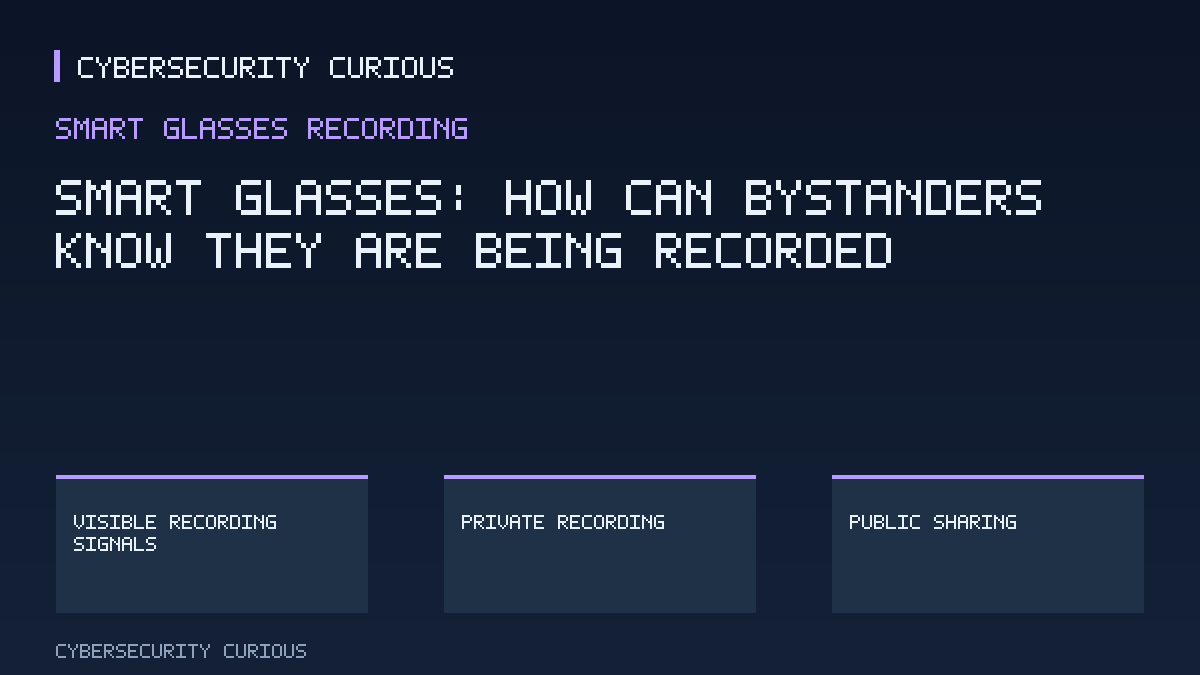
Smart Glasses: How Can Bystanders Know They Are Being Recorded?

Would you notice the camera?

Would you know if someone’s glasses were recording you? Smart glasses can combine ordinary-looking frames with cameras, microphones and an internet connection. Their discreet appearance creates a privacy problem: people nearby may not realise they are being recorded or understand who is using information about them and why.

On 13 October 2026, the European Data Protection Board adopted Statement 1/2026 on smart glasses. It offers preliminary guidance under the European Union’s General Data Protection Regulation (GDPR), its law governing the use of personal data—information about individuals. The statement provides guidance on existing law; it is not a new recording law.

What makes a recording signal useful?

The Board recommends making recording obvious through signals such as bright indicator lights, sounds or distinctive designs. Those signals should be reliable and hard to overlook. For you as a bystander, a useful signal answers the immediate question: is recording happening now? The Board also highlights the wider need to understand who is using your information and for what purpose.

In this hypothetical example, you record friends during a picnic while nearby visitors enter the frame. Consider telling your friends before recording and checking whether others can notice the signal. Before sharing the clip publicly, consider whether it includes people who had no reason to expect that audience.

Private use and public sharing differ

The household exemption excludes purely personal activities from the GDPR’s scope. The Board gives private recordings of family or friends as examples, while identifying sharing on a public social media account as a use that brings GDPR responsibilities. Actual use matters: calling a recording “personal” does not settle the question. Other laws may still apply even where the exemption does.

Before recording, consider three questions: who could enter the frame, how would they notice, and where will the recording go? If public sharing is your aim, consider that wider audience before pressing record.

References

  1. EDPB publishes statement on the data protection challenges of smart glasses | European Data Protection Board
  2. Statement 1/2026 of the EDPB on smart glasses | European Data Protection Board
Comments closed

Cybersecurity Awareness: Understanding the Next Decision

What does cybersecurity awareness help you notice?

Cybersecurity awareness means understanding digital threats and the harm they can cause. Its practical value begins when you connect that understanding to a request in front of you: what does it ask you to reveal or allow? Phishing provides a useful starting point. The European Commission describes it as fraudulent messages or websites designed to steal data or gain unauthorised access. [1]

Think of that definition as a lens for examining a request. Instead of considering only what a message says, consider what following it would give someone. A request can make a claim about your account while also asking you to disclose information. Those are separate things to assess: the explanation offered and the action requested. [1]

What can awareness surveys actually tell you?

In its announcement of 30 September 2026, the European Commission reported that three in four EU employees had encountered suspicious emails, messages or links at work. It also reported that 83% considered the potential consequences of cyberattacks serious, while 48% said they could recognise an artificial intelligence-generated fake video. [1]

These findings answer different questions. Encountering suspicious content describes reported exposure. Considering attacks serious describes concern. Saying you can recognise a fake video describes confidence in a particular ability. The percentages do not measure successive stages of the same test, so subtracting one from another would not establish how many people lack a security skill. [1]

For you as a reader, the useful distinction is between believing you could recognise deception and demonstrating that ability in a particular situation. The reported figures alone cannot establish whether someone correctly assessed a message or chose an effective response. They provide context for learning, without predicting your next decision. [1]

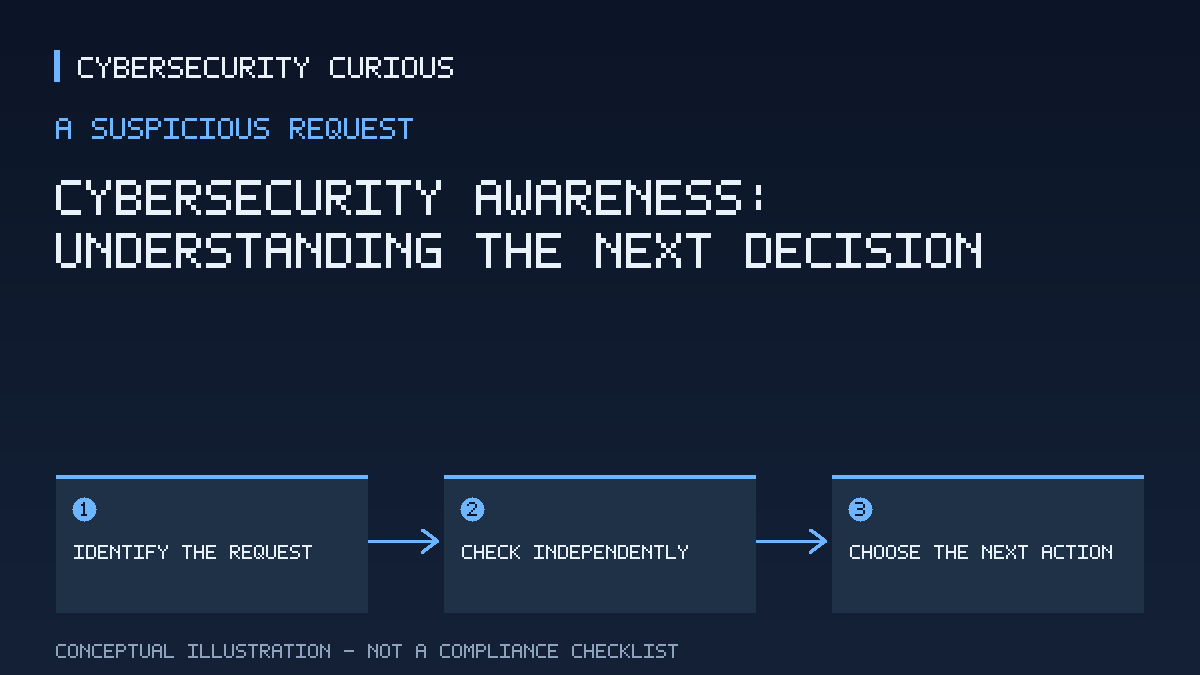
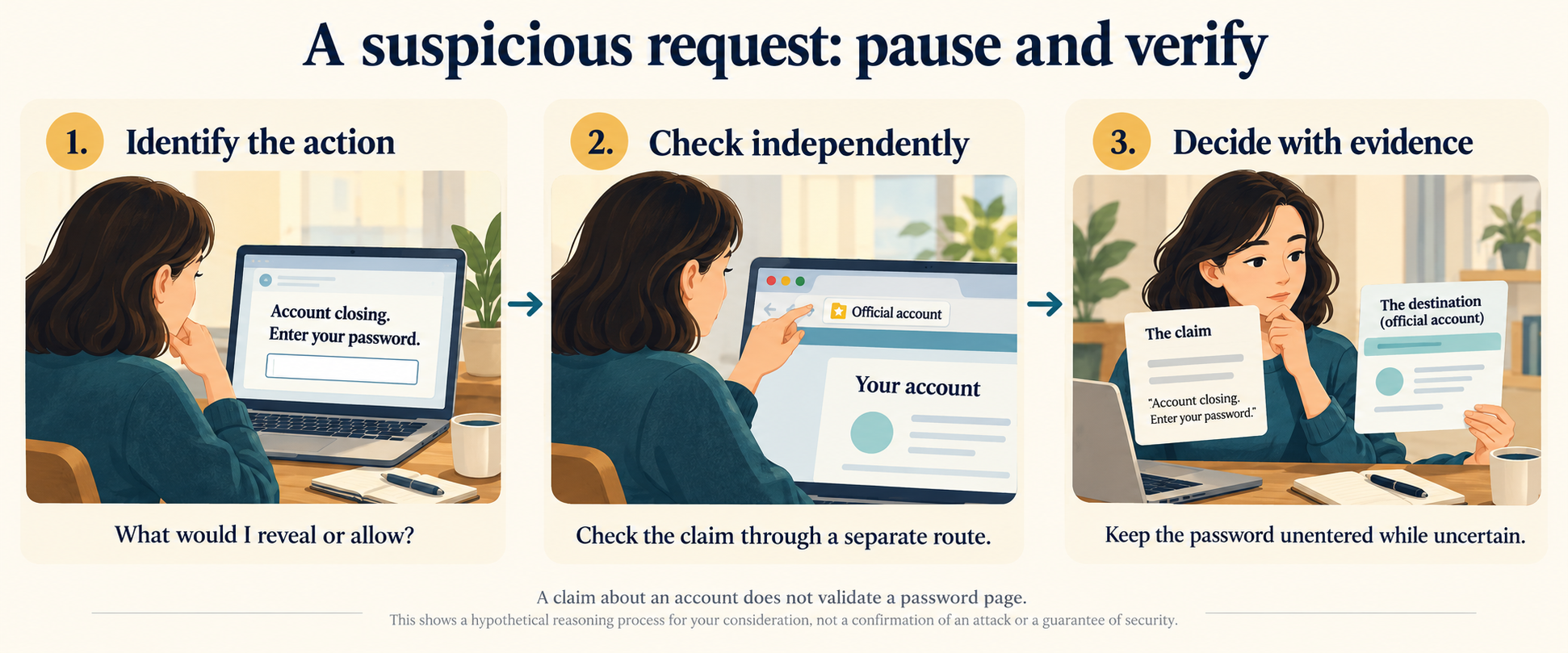
Three steps for assessing a suspicious password request: identify the action, check the account independently, and leave the password unentered while uncertain.
A suspicious message: identify what it asks you to do, check its claims independently, and decide before sharing sensitive information.

How could you think through a suspicious request?

In this hypothetical example, you receive a message saying that your account will become unavailable unless you open a linked page and enter your password. The message presents a problem and an immediate solution. Consider setting that explanation aside briefly and describing the requested action plainly: enter a password into a page supplied by the message. [1]

Next, consider what is at stake. Here, the requested information is a password, and the concern is the access associated with it. This connects the request to the purpose described in the Commission's phishing definition. It gives you a concrete reason to examine the request, although it does not prove that the message is fraudulent. [1]

Then separate the two claims you would need to assess: whether your account really faces interruption, and whether this page is an appropriate place to enter your password. Evidence supporting the first claim would not automatically settle the second. Consider asking what supports each conclusion instead of treating the whole message as a single true-or-false statement. [1]

Finally, consider choosing an action that preserves your ability to check. You could leave the password unentered while seeking confirmation independently of the message. This is a suggested way to handle the unresolved question, rather than a conclusion that an attack has occurred. The useful outcome is a clearer decision: you have identified the sensitive action and what remains uncertain before taking it. [1]

Put awareness within a wider response

A useful learning habit is to ask what a suspicious request seeks, what supports its claims, and what you can reasonably decide with the information available. Consider practising that reasoning alongside learning threat terminology. Naming phishing helps explain its purpose; examining the requested action connects that knowledge to a decision. [1]

Awareness has limits. The European Commission's broader cybersecurity policy also addresses preparedness, detection, response and recovery: anticipating incidents, identifying them, dealing with them and restoring affected activities. You cannot conclude from recognising a suspicious message that an account is secure or that an incident has been contained. When the question concerns possible harm already caused, further assessment may be needed beyond deciding whether to follow the request. [2]

References

  1. Three in four EU employees faced cyber threats at work, new Eurobarometer finds | Shaping Europe’s digital future (checked 2026-10-15)
  2. EU cybersecurity policies | Shaping Europe’s digital future (checked 2026-10-15)

Educational content; verify applicable requirements with the relevant primary sources.

Comments closed

Who Can Accept Cyber Risk? Understanding Decision Accountability

1. Start with the decision, then identify the authority

Who can accept cyber risk? Editorial answer: a person or body whose assigned authority covers the consequences of that decision. A cybersecurity assessment informs the choice, but expertise alone does not establish approval authority. NIST Cybersecurity Framework (CSF) 2.0 provides a useful foundation: its Govern function addresses risk tolerances, roles, responsibilities, and alignment with enterprise risk management. These concepts help frame the question without supplying a universal approval hierarchy. [2]

NIST released CSF 2.0 on February 26, 2024, adding Govern to Identify, Protect, Detect, Respond, and Recover. NIST explains that cybersecurity belongs alongside other enterprise risks, including financial and reputational concerns. This article takes an evergreen educational angle rather than reporting a recent change. The recommendations below are editorial applications of those governance concepts; they are not a prescribed NIST approval procedure. [1]

2. Separate acceptance, tolerance, and assessment

NIST lists acceptance among possible risk responses, alongside mitigation, transfer, and avoidance. It connects the choice of response with potential effects on critical service delivery. Working explanation for this article: cyber risk acceptance is a decision to tolerate an identified cybersecurity exposure. This is an editorial explanation, not a formal NIST definition. Acceptance describes the chosen response; it does not demonstrate that the exposure has been reduced. [2]

NIST also explains that understanding risk tolerance helps organizations prioritize cybersecurity activities and spending. Working distinction for this article: tolerance provides the context for judging what exposure is bearable, while acceptance concerns a particular exposure. Assessment supplies information for that judgment. Keeping these ideas separate helps readers distinguish an explanation of possible harm from the authority to decide whether that harm is tolerable. [2]

Editorial recommendation: begin an acceptance discussion with the affected outcome, possible consequences, and important uncertainties. Then explain how the proposed response relates to organizational priorities and tolerance. A risk rating can support that discussion, but a rating without a consequence statement leaves the decision difficult to interpret. NIST's guidance supports prioritization according to mission requirements, risk tolerances, and resources rather than a single universal threshold. [2]

3. Match authority to the consequences

NIST describes the CSF as applicable across organizational levels and most effective within broader enterprise risk management. It also explains how senior leaders can use the framework to understand, direct, and manage cybersecurity risk. Editorial reasoning: the relevant authority should therefore be considered in relation to the activities and consequences affected, rather than inferred solely from who identified the technical concern. [2]

Editorial recommendation: distinguish three contributions to the discussion. The assessor explains the exposure and uncertainty. Someone responsible for the affected activity explains the operational consequences. The authorized decision maker considers the response against priorities, tolerance, and available resources. These contributions may overlap, but identifying them makes missing information easier to recognize. This allocation is a suggested discussion structure, not a requirement for particular job titles or separate individuals. [2]

Editorial reasoning: the breadth of the consequences matters. An assessment focused on one activity may overlook effects on other activities, shared resources, or organizational objectives. Where those effects extend beyond a proposed decision maker's remit, the approval arrangement needs to address that wider scope. This follows NIST's emphasis on enterprise risk; it does not establish that every acceptance requires a board decision or an executive signature. [1] [2]

4. Hypothetical example: a recovery gap

Hypothetical example: a generic organization wants appointment scheduling to resume by the next working morning after a cyber disruption. Its hypothetical assessment indicates that recovery could instead take several working days. During that period, appointments could be missed and rescheduling could become difficult. All details are invented for illustration. The example connects a cybersecurity recovery concern with an understandable consequence for an activity. [2]

In this hypothetical example, the desired recovery outcome and assessed capability differ. NIST's Current and Target Profiles offer a way to describe such differences: a Current Profile identifies outcomes being achieved, while a Target Profile describes desired outcomes. Comparing them can reveal gaps and support prioritization. Editorial reasoning: making the gap visible helps define the decision, but the comparison alone does not establish that acceptance is appropriate. [2]

Continuing the hypothetical example: the assessor explains the recovery estimate and its uncertainty, while the person responsible for appointment delivery describes the disruption. An authorized decision maker then considers improvement options and the exposure that would remain if improvement were deferred. If acceptance is chosen, the next-morning objective remains unmet. Editorial reasoning: an acceptance decision should make that unresolved difference visible rather than present approval as evidence of improved recovery. [2]

5. Preserve the reasoning behind the choice

Editorial recommendation: retain a concise explanation of the affected outcome, assessment uncertainty, alternatives considered, chosen response, decision authority, and assumptions supporting the choice. These are suggested discussion prompts, not mandatory NIST record fields. Their purpose is to make the relationship between evidence and decision understandable. NIST supports communicating cybersecurity outcomes and expectations among leadership, operational personnel, and other stakeholders. [2]

In the hypothetical scheduling example, that explanation would connect the recovery delay with appointment disruption and state why the authorized decision maker considers the remaining exposure tolerable. Editorial reasoning: it should also distinguish the desired improvement from what is currently achievable. That distinction gives a later reviewer something concrete to reconsider: the consequence, the response options, or the assumptions may change even when the recorded approval remains the same. [2]

6. Keep framework guidance separate from legal obligations

CSF 2.0 is cybersecurity risk guidance from NIST, a United States public institution. NIST states that it is not a regulatory agency and that most organizations use the framework voluntarily. The CSF sets out outcomes without prescribing a universal process for achieving them. Its international use does not create a shared legal rule about who may accept cyber risk, and using it does not guarantee compliance. [1] [2]

NIST explains that cybersecurity objectives may reflect applicable laws, rules, and regulations, and that Govern includes understanding and managing legal, regulatory, and contractual requirements. Editorial recommendation: consider those requirements before treating acceptance as an available response. This article makes no jurisdiction-specific legal determination and assigns no statutory approval duty. A governance decision and a determination that applicable obligations have been satisfied answer different questions. [2]

7. Reconsider decisions when their basis changes

NIST describes the six CSF functions as concurrent and continuous. It also explains that Target Profiles consider anticipated changes, including new requirements, technology adoption, and threat information. Editorial recommendation: connect review of an acceptance decision to changes in its supporting assumptions. Useful questions include whether the assessed consequences remain credible, whether uncertainty has increased, and whether the chosen response still fits organizational priorities. [2]

Returning to the hypothetical scheduling example: greater dependence on appointments, a longer recovery estimate, or a newly feasible improvement could prompt reconsideration. These are invented review triggers, not NIST thresholds. Editorial reasoning: review becomes more useful when it asks what has changed in the decision's basis. Repeating the original approval without examining that basis would provide little insight into whether the exposure remains tolerable. [2]

References

  1. NIST Releases Version 2.0 of Landmark Cybersecurity Framework | NIST Lock (checked 2026-10-14)
  2. Frequently Asked Questions | NIST Lock (checked 2026-10-14)

Educational content; verify applicable requirements with the relevant primary sources.

Comments closed

What is Hashing?

In previous posts, I covered symmetric and asymmetric encryption. Both help protect information by making it unreadable without the correct key. Another term that often comes up alongside encryption is hashing. So, what is hashing, and where does it fit into cybersecurity?

Hashing Basics

Hashing takes an input, such as a message or a file, and calculates a value called a hash or digest. With an algorithm such as SHA-256, the output has a fixed length regardless of whether the input is a short sentence or a large download.

Think of it as a digital fingerprint. You can compare fingerprints to help check whether data has changed, without comparing every part of the original files yourself.

The same input produces the same hash when the same algorithm is used. Even a small change, such as replacing one letter, will usually produce a very different result. Secure cryptographic hash functions are also designed to make it impractical to recover an input from its hash or deliberately find two different inputs with the same hash. Such a matching pair is called a collision.

Hashing vs. Encryption

The main difference is their purpose:

  • Encryption protects confidentiality. Someone with the correct key can decrypt the information and read it again.
  • Hashing produces a digest for comparison. There is no decryption key that turns the hash back into the original message.

However, this does not mean that hashing makes a weak password impossible to discover. An attacker can hash likely guesses and compare the results.

Example Use Case: Checking a Download

Imagine you download a software installer and the publisher provides its SHA-256 hash.

  1. Download the file from the publisher’s official website.
  2. Calculate the SHA-256 hash of the downloaded file using a local tool.
  3. Compare your result with the hash published by the developer.

If the values differ, the file does not match the expected download. It may be incomplete, corrupted or modified.

A matching hash is only as trustworthy as the reference you compare it against. If an attacker replaces both the file and the published hash, that comparison alone will not expose the change. It also does not prove that the software itself is harmless.

How Does Hashing Help Protect Passwords?

A service should normally store a password hash rather than the password itself. When you sign in, the service uses a password verification function to check your entry against the stored result.

Password storage needs a dedicated algorithm, such as Argon2id, and a unique random salt for each password. A salt is stored alongside the hash and helps prevent identical passwords from producing identical stored results. Password hashing algorithms deliberately make guessing more expensive; a fast general-purpose hash such as SHA-256 alone is not suitable for storing passwords.

Why Does It Matter?

Hashing helps us check file integrity and is part of systems that verify passwords and digital signatures. It serves a different purpose from encryption, but both are useful building blocks for protecting information.

The next time you see a long SHA-256 value beside a download, you will know what it is there for: a way to compare the file you received with the file you expected.

Further Reading

Comments closed

What is CyScan.io


CyScan.io, also known as Cyber URL Scanner, is a simple online tool to check websites before you interact with them. Built by cybersecurity professionals, it does real-time scanning to detect threats hidden behind a link — malware, phishing traps or invasive tracking scripts.

With one click you get the full picture of a site’s safety — which is handy in today’s internet full of hidden dangers and deceptive links.


What is cool:

🔍 Real-Time URL Scanning

CyScan doesn’t give you a “safe/unsafe” score — it actively analyzes URLs to detect malicious code, phishing patterns, tracking technologies and other signs of risk. You get instant feedback so you can make smart decisions before clicking.

⚙️ No Setup Required

No account, no installation, no technical knowledge required. Just paste a link and get results. Whether you’re a developer, IT admin or casual user, this makes CyScan easy to integrate in your daily routine.

📊 Clean Reports

Results are presented in a simple way — no jargon, no PDFs. Just a summary of detected threats, categorized by severity, with details even non-techies can understand.

🧠 No Noise, Just What Matters

I really liked how focused and minimalistic CyScan’s reporting is. It doesn’t overwhelm you with technical data — just the essentials. You see what matters, and nothing more.


Who Should Use CyScan.io?

CyScan.io isn’t just for cybersecurity professionals. It’s useful for:

  • Individuals who want to check if a link is safe before clicking
  • Freelancers and web developers managing multiple websites
  • Digital agencies performing basic security hygiene for clients
  • Anyone who wants a quick and easy way to stay safe online

Final Thoughts:
CyScan.io isn’t a full-stack vulnerability scanner and it doesn’t pretend to be. But for quick and easy website safety checks it does exactly what it promises — and does it well. Whether you’re techy or not, it’s a tool to bookmark.

Comments closed

Asymmetric Encryption

Decrypt Everything: Understanding Asymmetric Encryption

Introduction:
In today’s digital world, protecting our data is crucial. Encryption plays a key role in keeping our sensitive information secure during transmission. Among the different encryption methods, asymmetric encryption stands out due to its unique approach and robust security features. So, what exactly is asymmetric encryption, and why is it so essential?

Encryption Basics:
Encryption is the process of transforming plain text into coded text, making it unreadable to unauthorized users. This ensures that only those with the correct key can decrypt and access the original information. There are two main types of encryption: symmetric and asymmetric. In symmetric encryption, the same key is used for both encryption and decryption. Asymmetric encryption, on the other hand, uses two keys: a private key and a public key.

What is Asymmetric Encryption?
Asymmetric encryption, also known as public-key cryptography, involves a pair of keys that are mathematically related: a public key and a private key. The public key is used to encrypt data, while the private key is used to decrypt it. The public key can be shared openly, but the private key must be kept secure. This ensures that even if someone intercepts the encrypted data, they cannot decrypt it without the private key.

How Does Asymmetric Encryption Work?
Here’s a simple breakdown of how asymmetric encryption works:

  1. Key Pair Generation: A pair of keys—a public key and a private key—is created.
  2. Public Key Distribution: The public key is shared with the intended recipient(s).
  3. Data Encryption: The sender encrypts the data using the recipient’s public key.
  4. Sending the Encrypted Data: The encrypted data is sent to the recipient over a secure channel.
  5. Data Decryption: The recipient uses their private key to decrypt the data and access the original information.

Example Use Case:
Imagine Alice wants to send Bob a private message. Bob shares his public key with Alice. Alice uses Bob’s public key to encrypt her message and then sends the encrypted message to Bob. Bob can then decrypt the message using his private key, ensuring that only he can read it.

Advantages of Asymmetric Encryption:
Asymmetric encryption offers several advantages over symmetric encryption:

  1. Enhanced Security: The use of two keys makes it more secure and harder for attackers to access the data.
  2. Public Key Distribution: Public keys can be shared widely without compromising the security of the private key.
  3. Digital Signatures: Asymmetric encryption enables digital signatures, which verify the authenticity and integrity of messages and documents.

Applications of Asymmetric Encryption:
Asymmetric encryption is used in various important applications:

  1. Secure Communications: Email encryption (e.g., Pretty Good Privacy, or PGP) uses asymmetric encryption to ensure message privacy.
  2. Digital Certificates and SSL/TLS: Protocols like SSL/TLS use asymmetric encryption to secure online transactions and communications.
  3. Blockchain and Cryptocurrency: Asymmetric encryption is crucial in blockchain technology and cryptocurrencies for securing and verifying transactions.

Challenges and Considerations:
While asymmetric encryption has many benefits, it also presents some challenges:

  1. Computational Demand: Asymmetric encryption requires more computational power than symmetric encryption, which can affect performance.
  2. Key Management: Safeguarding the private key is critical, as losing or compromising it can lead to data breaches.

Conclusion:
Asymmetric encryption is a fundamental component of modern cybersecurity. Understanding how it works and its various applications highlights its importance in protecting our digital world. As technology continues to evolve, asymmetric encryption will remain a vital tool in combating cyber threats, keeping our information safe and secure.

1 Comment

What is Symmetric Encryption?

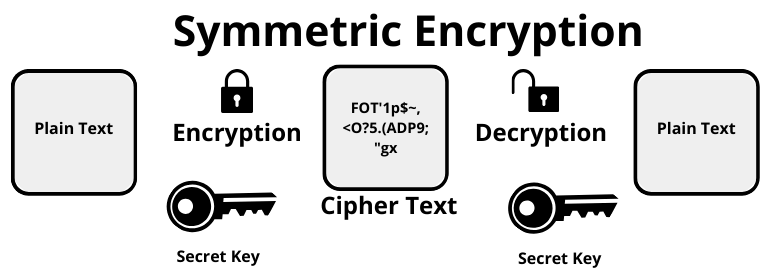
Symmetric encryption is a method of protecting data by using a private key to encrypt (lock) and decrypt (unlock) it. Both the sender and recipient must possess this key, which could be a word, passphrase, or complex combination of characters, numbers, and symbols, to access encrypted information.

One advantage for organizations using this type of encryption is its cost-effectiveness. However, it does come with certain drawbacks. In symmetric encryption, keys can remain usable indefinitely, leading organizations to simply forget to perform periodic key changes. Consequently, former employees in such cases can still access and decipher encrypted data.

Illustration of Symmetric Encryption
1 Comment

Vulnerability, Threat and Risk

Part of security teams duties is to check their systems, and they need to figure out how someone might try to break in. They would look for weak spots, possible dangers and things that could go wrong.

In this post I’ll speak about difference between Vulnerability, Threat And Risk.

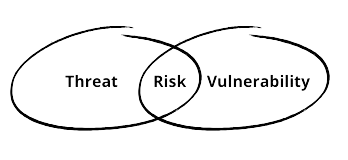
  • Vulnerability is a weakness, or to put it simply, a flaw in a system that could be exploited to breach security. While there’s no such thing as a completely secure system, and we often see Zero-Day exploits (vulnerability before it’s patched) happening, we can at least try to protect our systems by applying the latest patches to firmware and software, as well as properly configuring the system and hardware.
  • Threat is possibility of someone or something exploiting a weakness to breach security,
    whether intentionally or unintentionally. The individual or thing responsible for threat is known as threat actor or threat agent. Attack vector is the pathway or method used by threat actors to breach a network.
  • Risk is the chance of using a weakness to break into a system. We need to assess these risks, which are vulnerabilities we find. Then, we can figure out how likely it is for a bad actor to exploit them and what damage that could cause.

For basic risk assessments, we can use a simple formula:

Risk = (Threat x Vulnerability ) x Impact
Comments closed