Skip to content

Category: Uncategorized

Cybersecurity Awareness: Understanding the Next Decision

What does cybersecurity awareness help you notice?

Cybersecurity awareness means understanding digital threats and the harm they can cause. Its practical value begins when you connect that understanding to a request in front of you: what does it ask you to reveal or allow? Phishing provides a useful starting point. The European Commission describes it as fraudulent messages or websites designed to steal data or gain unauthorised access. [1]

Think of that definition as a lens for examining a request. Instead of considering only what a message says, consider what following it would give someone. A request can make a claim about your account while also asking you to disclose information. Those are separate things to assess: the explanation offered and the action requested. [1]

What can awareness surveys actually tell you?

In its announcement of 30 September 2026, the European Commission reported that three in four EU employees had encountered suspicious emails, messages or links at work. It also reported that 83% considered the potential consequences of cyberattacks serious, while 48% said they could recognise an artificial intelligence-generated fake video. [1]

These findings answer different questions. Encountering suspicious content describes reported exposure. Considering attacks serious describes concern. Saying you can recognise a fake video describes confidence in a particular ability. The percentages do not measure successive stages of the same test, so subtracting one from another would not establish how many people lack a security skill. [1]

For you as a reader, the useful distinction is between believing you could recognise deception and demonstrating that ability in a particular situation. The reported figures alone cannot establish whether someone correctly assessed a message or chose an effective response. They provide context for learning, without predicting your next decision. [1]
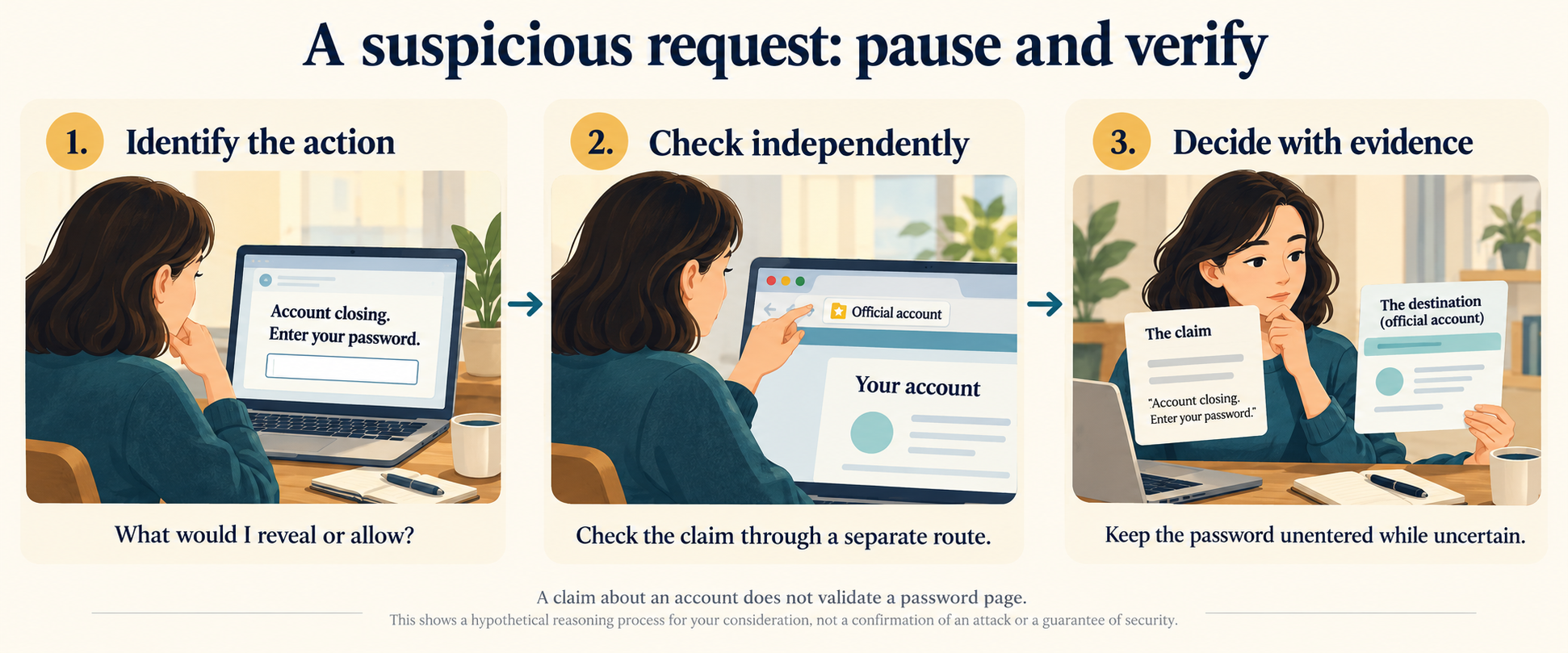
Three steps for assessing a suspicious password request: identify the action, check the account independently, and leave the password unentered while uncertain.
A suspicious message: identify what it asks you to do, check its claims independently, and decide before sharing sensitive information.

How could you think through a suspicious request?

In this hypothetical example, you receive a message saying that your account will become unavailable unless you open a linked page and enter your password. The message presents a problem and an immediate solution. Consider setting that explanation aside briefly and describing the requested action plainly: enter a password into a page supplied by the message. [1]

Next, consider what is at stake. Here, the requested information is a password, and the concern is the access associated with it. This connects the request to the purpose described in the Commission's phishing definition. It gives you a concrete reason to examine the request, although it does not prove that the message is fraudulent. [1]

Then separate the two claims you would need to assess: whether your account really faces interruption, and whether this page is an appropriate place to enter your password. Evidence supporting the first claim would not automatically settle the second. Consider asking what supports each conclusion instead of treating the whole message as a single true-or-false statement. [1]

Finally, consider choosing an action that preserves your ability to check. You could leave the password unentered while seeking confirmation independently of the message. This is a suggested way to handle the unresolved question, rather than a conclusion that an attack has occurred. The useful outcome is a clearer decision: you have identified the sensitive action and what remains uncertain before taking it. [1]

Put awareness within a wider response

A useful learning habit is to ask what a suspicious request seeks, what supports its claims, and what you can reasonably decide with the information available. Consider practising that reasoning alongside learning threat terminology. Naming phishing helps explain its purpose; examining the requested action connects that knowledge to a decision. [1]

Awareness has limits. The European Commission's broader cybersecurity policy also addresses preparedness, detection, response and recovery: anticipating incidents, identifying them, dealing with them and restoring affected activities. You cannot conclude from recognising a suspicious message that an account is secure or that an incident has been contained. When the question concerns possible harm already caused, further assessment may be needed beyond deciding whether to follow the request. [2]

References

  1. Three in four EU employees faced cyber threats at work, new Eurobarometer finds | Shaping Europe’s digital future (checked 2026-10-15)
  2. EU cybersecurity policies | Shaping Europe’s digital future (checked 2026-10-15)

Educational content; verify applicable requirements with the relevant primary sources.

Comments closed

Who Can Accept Cyber Risk? Understanding Decision Accountability

1. Start with the decision, then identify the authority

Who can accept cyber risk? Editorial answer: a person or body whose assigned authority covers the consequences of that decision. A cybersecurity assessment informs the choice, but expertise alone does not establish approval authority. NIST Cybersecurity Framework (CSF) 2.0 provides a useful foundation: its Govern function addresses risk tolerances, roles, responsibilities, and alignment with enterprise risk management. These concepts help frame the question without supplying a universal approval hierarchy. [2]

NIST released CSF 2.0 on February 26, 2024, adding Govern to Identify, Protect, Detect, Respond, and Recover. NIST explains that cybersecurity belongs alongside other enterprise risks, including financial and reputational concerns. This article takes an evergreen educational angle rather than reporting a recent change. The recommendations below are editorial applications of those governance concepts; they are not a prescribed NIST approval procedure. [1]

2. Separate acceptance, tolerance, and assessment

NIST lists acceptance among possible risk responses, alongside mitigation, transfer, and avoidance. It connects the choice of response with potential effects on critical service delivery. Working explanation for this article: cyber risk acceptance is a decision to tolerate an identified cybersecurity exposure. This is an editorial explanation, not a formal NIST definition. Acceptance describes the chosen response; it does not demonstrate that the exposure has been reduced. [2]

NIST also explains that understanding risk tolerance helps organizations prioritize cybersecurity activities and spending. Working distinction for this article: tolerance provides the context for judging what exposure is bearable, while acceptance concerns a particular exposure. Assessment supplies information for that judgment. Keeping these ideas separate helps readers distinguish an explanation of possible harm from the authority to decide whether that harm is tolerable. [2]

Editorial recommendation: begin an acceptance discussion with the affected outcome, possible consequences, and important uncertainties. Then explain how the proposed response relates to organizational priorities and tolerance. A risk rating can support that discussion, but a rating without a consequence statement leaves the decision difficult to interpret. NIST's guidance supports prioritization according to mission requirements, risk tolerances, and resources rather than a single universal threshold. [2]

3. Match authority to the consequences

NIST describes the CSF as applicable across organizational levels and most effective within broader enterprise risk management. It also explains how senior leaders can use the framework to understand, direct, and manage cybersecurity risk. Editorial reasoning: the relevant authority should therefore be considered in relation to the activities and consequences affected, rather than inferred solely from who identified the technical concern. [2]

Editorial recommendation: distinguish three contributions to the discussion. The assessor explains the exposure and uncertainty. Someone responsible for the affected activity explains the operational consequences. The authorized decision maker considers the response against priorities, tolerance, and available resources. These contributions may overlap, but identifying them makes missing information easier to recognize. This allocation is a suggested discussion structure, not a requirement for particular job titles or separate individuals. [2]

Editorial reasoning: the breadth of the consequences matters. An assessment focused on one activity may overlook effects on other activities, shared resources, or organizational objectives. Where those effects extend beyond a proposed decision maker's remit, the approval arrangement needs to address that wider scope. This follows NIST's emphasis on enterprise risk; it does not establish that every acceptance requires a board decision or an executive signature. [1] [2]

4. Hypothetical example: a recovery gap

Hypothetical example: a generic organization wants appointment scheduling to resume by the next working morning after a cyber disruption. Its hypothetical assessment indicates that recovery could instead take several working days. During that period, appointments could be missed and rescheduling could become difficult. All details are invented for illustration. The example connects a cybersecurity recovery concern with an understandable consequence for an activity. [2]

In this hypothetical example, the desired recovery outcome and assessed capability differ. NIST's Current and Target Profiles offer a way to describe such differences: a Current Profile identifies outcomes being achieved, while a Target Profile describes desired outcomes. Comparing them can reveal gaps and support prioritization. Editorial reasoning: making the gap visible helps define the decision, but the comparison alone does not establish that acceptance is appropriate. [2]

Continuing the hypothetical example: the assessor explains the recovery estimate and its uncertainty, while the person responsible for appointment delivery describes the disruption. An authorized decision maker then considers improvement options and the exposure that would remain if improvement were deferred. If acceptance is chosen, the next-morning objective remains unmet. Editorial reasoning: an acceptance decision should make that unresolved difference visible rather than present approval as evidence of improved recovery. [2]

5. Preserve the reasoning behind the choice

Editorial recommendation: retain a concise explanation of the affected outcome, assessment uncertainty, alternatives considered, chosen response, decision authority, and assumptions supporting the choice. These are suggested discussion prompts, not mandatory NIST record fields. Their purpose is to make the relationship between evidence and decision understandable. NIST supports communicating cybersecurity outcomes and expectations among leadership, operational personnel, and other stakeholders. [2]

In the hypothetical scheduling example, that explanation would connect the recovery delay with appointment disruption and state why the authorized decision maker considers the remaining exposure tolerable. Editorial reasoning: it should also distinguish the desired improvement from what is currently achievable. That distinction gives a later reviewer something concrete to reconsider: the consequence, the response options, or the assumptions may change even when the recorded approval remains the same. [2]

6. Keep framework guidance separate from legal obligations

CSF 2.0 is cybersecurity risk guidance from NIST, a United States public institution. NIST states that it is not a regulatory agency and that most organizations use the framework voluntarily. The CSF sets out outcomes without prescribing a universal process for achieving them. Its international use does not create a shared legal rule about who may accept cyber risk, and using it does not guarantee compliance. [1] [2]

NIST explains that cybersecurity objectives may reflect applicable laws, rules, and regulations, and that Govern includes understanding and managing legal, regulatory, and contractual requirements. Editorial recommendation: consider those requirements before treating acceptance as an available response. This article makes no jurisdiction-specific legal determination and assigns no statutory approval duty. A governance decision and a determination that applicable obligations have been satisfied answer different questions. [2]

7. Reconsider decisions when their basis changes

NIST describes the six CSF functions as concurrent and continuous. It also explains that Target Profiles consider anticipated changes, including new requirements, technology adoption, and threat information. Editorial recommendation: connect review of an acceptance decision to changes in its supporting assumptions. Useful questions include whether the assessed consequences remain credible, whether uncertainty has increased, and whether the chosen response still fits organizational priorities. [2]

Returning to the hypothetical scheduling example: greater dependence on appointments, a longer recovery estimate, or a newly feasible improvement could prompt reconsideration. These are invented review triggers, not NIST thresholds. Editorial reasoning: review becomes more useful when it asks what has changed in the decision's basis. Repeating the original approval without examining that basis would provide little insight into whether the exposure remains tolerable. [2]

References

  1. NIST Releases Version 2.0 of Landmark Cybersecurity Framework | NIST Lock (checked 2026-10-14)
  2. Frequently Asked Questions | NIST Lock (checked 2026-10-14)

Educational content; verify applicable requirements with the relevant primary sources.

Comments closed