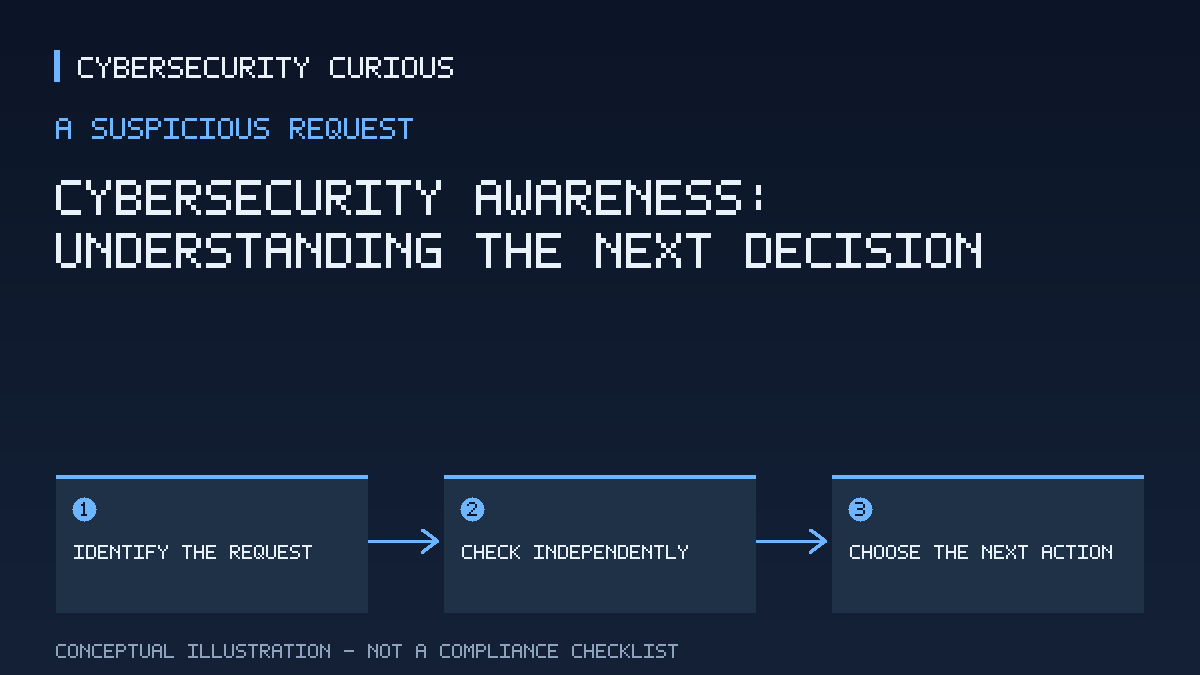
What does cybersecurity awareness help you notice?
Cybersecurity awareness means understanding digital threats and the harm they can cause. Its practical value begins when you connect that understanding to a request in front of you: what does it ask you to reveal or allow? Phishing provides a useful starting point. The European Commission describes it as fraudulent messages or websites designed to steal data or gain unauthorised access. [1]
Think of that definition as a lens for examining a request. Instead of considering only what a message says, consider what following it would give someone. A request can make a claim about your account while also asking you to disclose information. Those are separate things to assess: the explanation offered and the action requested. [1]
What can awareness surveys actually tell you?
In its announcement of 30 September 2026, the European Commission reported that three in four EU employees had encountered suspicious emails, messages or links at work. It also reported that 83% considered the potential consequences of cyberattacks serious, while 48% said they could recognise an artificial intelligence-generated fake video. [1]
These findings answer different questions. Encountering suspicious content describes reported exposure. Considering attacks serious describes concern. Saying you can recognise a fake video describes confidence in a particular ability. The percentages do not measure successive stages of the same test, so subtracting one from another would not establish how many people lack a security skill. [1]
For you as a reader, the useful distinction is between believing you could recognise deception and demonstrating that ability in a particular situation. The reported figures alone cannot establish whether someone correctly assessed a message or chose an effective response. They provide context for learning, without predicting your next decision. [1]
How could you think through a suspicious request?
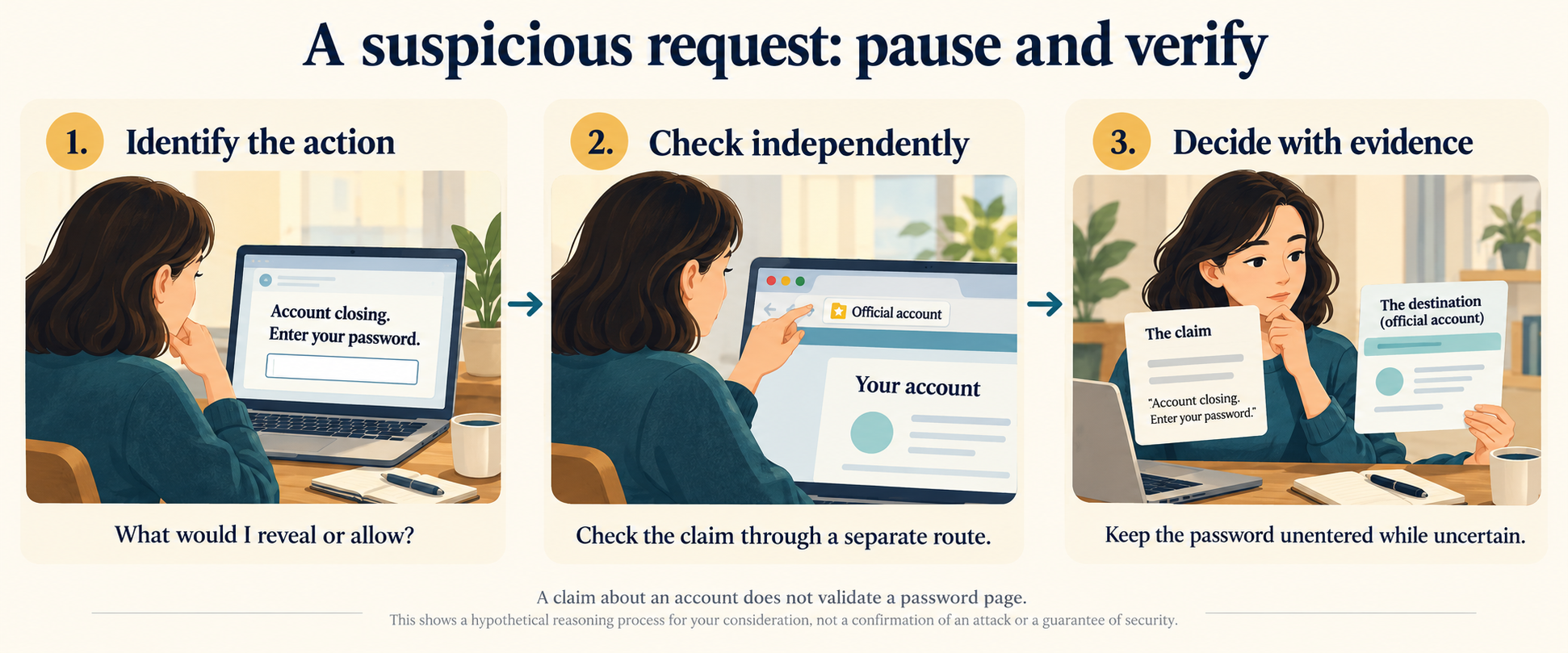
In this hypothetical example, you receive a message saying that your account will become unavailable unless you open a linked page and enter your password. The message presents a problem and an immediate solution. Consider setting that explanation aside briefly and describing the requested action plainly: enter a password into a page supplied by the message. [1]
Next, consider what is at stake. Here, the requested information is a password, and the concern is the access associated with it. This connects the request to the purpose described in the Commission's phishing definition. It gives you a concrete reason to examine the request, although it does not prove that the message is fraudulent. [1]
Then separate the two claims you would need to assess: whether your account really faces interruption, and whether this page is an appropriate place to enter your password. Evidence supporting the first claim would not automatically settle the second. Consider asking what supports each conclusion instead of treating the whole message as a single true-or-false statement. [1]
Finally, consider choosing an action that preserves your ability to check. You could leave the password unentered while seeking confirmation independently of the message. This is a suggested way to handle the unresolved question, rather than a conclusion that an attack has occurred. The useful outcome is a clearer decision: you have identified the sensitive action and what remains uncertain before taking it. [1]
Put awareness within a wider response
A useful learning habit is to ask what a suspicious request seeks, what supports its claims, and what you can reasonably decide with the information available. Consider practising that reasoning alongside learning threat terminology. Naming phishing helps explain its purpose; examining the requested action connects that knowledge to a decision. [1]
Awareness has limits. The European Commission's broader cybersecurity policy also addresses preparedness, detection, response and recovery: anticipating incidents, identifying them, dealing with them and restoring affected activities. You cannot conclude from recognising a suspicious message that an account is secure or that an incident has been contained. When the question concerns possible harm already caused, further assessment may be needed beyond deciding whether to follow the request. [2]
References
- Three in four EU employees faced cyber threats at work, new Eurobarometer finds | Shaping Europe’s digital future (checked 2026-10-15)
- EU cybersecurity policies | Shaping Europe’s digital future (checked 2026-10-15)
Educational content; verify applicable requirements with the relevant primary sources.